Every year, a few students in every good science section discover that they do not actually want to be engineers. They like Physics for its own sake, or Chemistry, or Mathematics — and nobody has told them that there is a serious, well-funded, nationally respected route for exactly that. The IISERs are that route, and the IISER Aptitude Test (IAT) is the single door into them.
This is a short guide to what the IISERs offer, how the IAT works, and how much extra work it really is for a student already preparing for JEE.
Please note: dates, fees, seat numbers and rules change every year. The details below are from the 2026 cycle, given so you know the shape of things. Do check iiseradmission.in and the official brochure before you act on anything with a deadline attached.
What the IISERs are
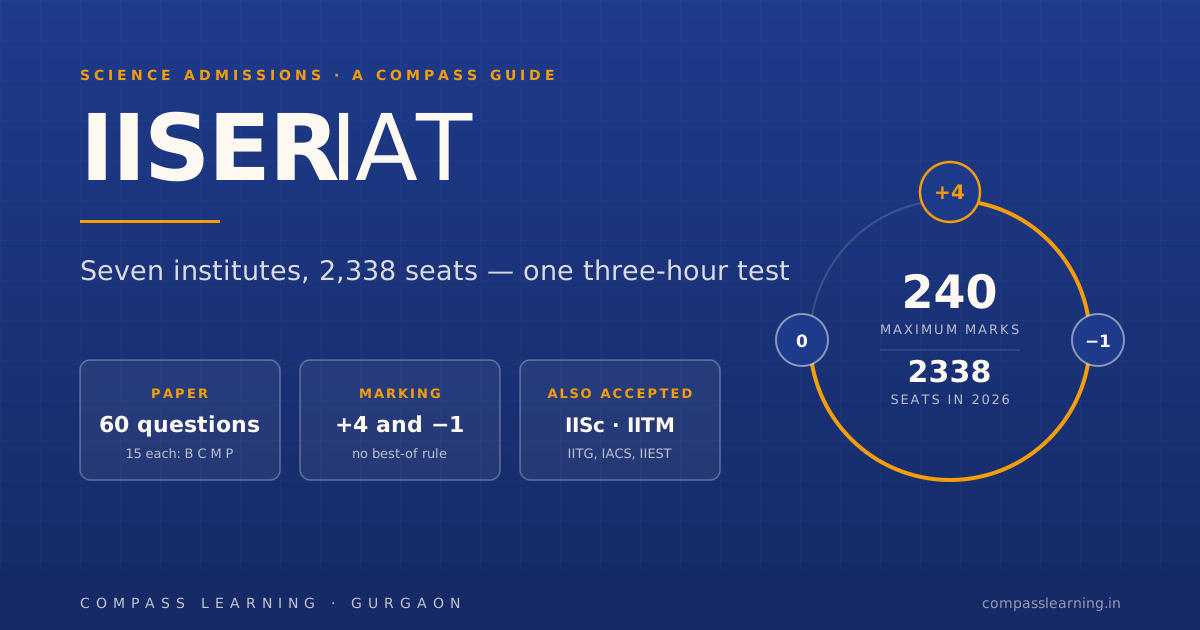
The Indian Institutes of Science Education and Research are seven institutes set up by the Government of India to teach science at the same level at which it is researched. They are at Berhampur, Bhopal, Kolkata, Mohali, Pune, Thiruvananthapuram and Tirupati, and together they offered about 2,338 seats in 2026.
The main programme is a five-year BS-MS dual degree — you walk out with both a Bachelor's and a Master's, and the last year is a research project. Several IISERs now offer more besides: four-year BS and B.Tech programmes at Bhopal and Tirupati, computational and data sciences at Kolkata, and geology and environmental sciences majors at Mohali.
Teaching is in small batches, laboratories are open to undergraduates from early on, and most students are taught by people doing active research. Many graduates go on to PhDs in India and abroad; a growing number move into data science, analytics and quantitative finance, where the mathematics training is valued.
The IAT — one exam, one door
There used to be several channels into the IISERs. There is now only one: the IAT. If your child wants an IISER, this is the exam.
The paper. A computer-based test of three hours, with 60 multiple-choice questions — 15 each from Biology, Chemistry, Mathematics and Physics. Each correct answer earns 4 marks and each wrong answer loses 1, so the score runs from −60 to a maximum of 240.
The point most PCM students miss. All four subjects appear in the paper, and there is no best-of rule. A student who did not take Biology in Class XI and XII is therefore competing on 45 of the 60 questions while others attempt all 60. That is not a reason to avoid the exam — plenty of PCM students get in — but it is a reason to plan. The Biology in the paper is NCERT-level and a motivated student can pick up a useful part of it in the last few months. Please confirm the current rule in the brochure, since the pattern has been revised before.
Eligibility. A candidate must have studied at least three of the four subjects — Biology, Chemistry, Mathematics, Physics — in Class XII, with a minimum aggregate of 60% (55% for SC, ST and PwD candidates). There is no age limit, and a student may attempt the IAT in at most three consecutive years.
The calendar. In 2026 applications opened on 5 March and closed on 13 April, and the exam was held on 7 June, 9 am to 12 noon. The fee was ₹2,000 for general candidates and ₹1,000 for reserved categories. The window is usually March to April, with the exam in the first half of June — which means it lands a few weeks after JEE Advanced.
The part that makes the IAT worth writing anyway
The IAT score is no longer accepted only by the IISERs. As of the 2026 cycle it also opens:
- IISc Bangalore — the four-year BS (Research), explained in our guide to IISc admission
- IIT Madras — BS in Chemistry, Medical Sciences, and Engineering
- IIT Guwahati — BS in Biomedical Science and Engineering
- IACS Kolkata and IIEST Shibpur — BS-MS programmes
For these institutes a student must register separately, before their counselling; the IAT score alone does not put you on their list automatically. Still, one exam, written a few weeks after JEE Advanced, on a syllabus you have already studied, that puts IISc and two IITs within reach — that is an unusually good return on three hours.
How much extra preparation is really needed
For a student already preparing for JEE, less than parents expect. The syllabus is the NCERT Class XI and XII course, which is familiar ground. What differs is the style: the IAT rewards quick, clean reasoning across many short questions rather than long multi-step problems, and it punishes guessing.
So the sensible plan is not a separate year of preparation. It is to keep the main preparation where it is, and in the last two months add timed practice on IAT-pattern papers — plus, for a PCM student, a quick NCERT pass through Biology if he is willing.
It is also worth reading about NISER and the NEST exam at the same time. NEST covers the same four subjects, falls within a day or two of the IAT, and counts only your best three sections — which makes it the friendlier of the two for a student without Biology.
If you are not sure whether your child belongs on the research route or the engineering one, do talk to us. It is a question worth settling in Class XI, not in June of Class XII.


